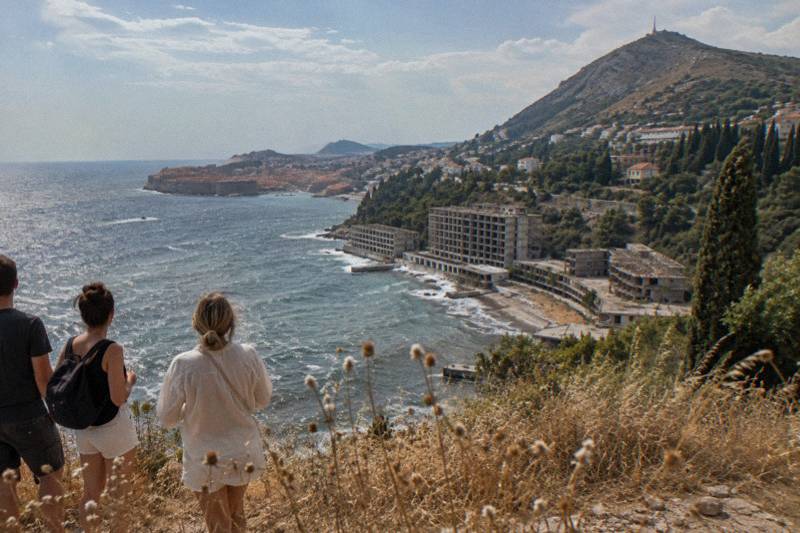
Why Is Kupari Still Abandoned?
Kupari, the former Yugoslav military resort near Dubrovnik, was abandoned after 1991, but the ruins were largely demolished in 2025 and the site is being redeveloped with no public access. Here is what you can still see and how to visit the area.
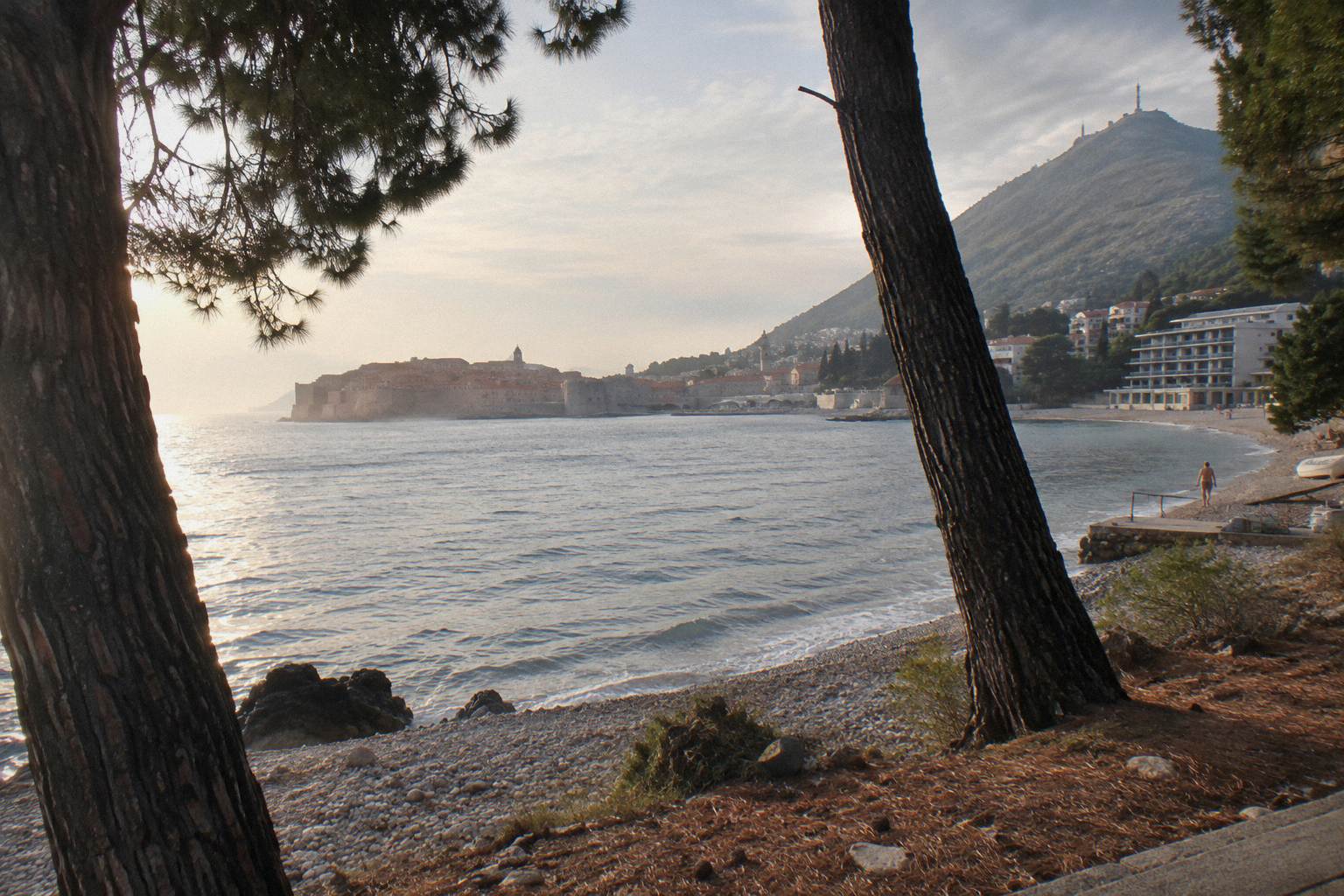
In short: Kupari, once the Yugoslav People's Army's holiday resort nicknamed "Tito's Hawaii", was plundered and damaged in 1991 and left empty for over thirty years. But the word "still" is now only partly true: the ruins were largely demolished in 2025, the protected Grand Hotel excepted, and the bay is being redeveloped as a luxury resort. There is no public access to the site today. If you want to see the place, the practical option is a driving tour that describes it from the road or a viewpoint, such as the Private War And Heritage Tour Of Mount Srđ by Adriatic Vision or the Half-Day Yugoslav War History by Amico Tours, which passes the wider area.
This page sits within the Dubrovnik war history coverage on Dubrovnik Communism Tours; for the wider 1991 to 1992 story, see the siege of Dubrovnik explained guide.
Quick Facts About Kupari Today
The short version of Kupari's story fits in one table: a Yugoslav military resort, plundered and damaged in 1991, empty for over three decades, largely demolished in 2025 with the protected Grand Hotel excepted, and now a closed luxury construction site. No tour enters the ruins. The bay can only be seen from the road or a viewpoint, and the driving tours that go there pair it with Mount Srd and the wider war landscape.
| Question | Answer |
|---|---|
| What was Kupari? | A military holiday resort of the Yugoslav People's Army, nicknamed "Tito's Hawaii" |
| What happened in 1991? | The resort was plundered and damaged |
| What is there now? | Ruins largely demolished in 2025; the protected Grand Hotel stands; redevelopment under way |
| Can you walk in? | No. The site has no public access |
| How do tours cover it? | From the road or a viewpoint, never inside |
| What else is nearby? | Hotel Belvedere ruins, Mount Srd, the Homeland War Museum, War Photo Limited |
Why Is Kupari Still Abandoned?
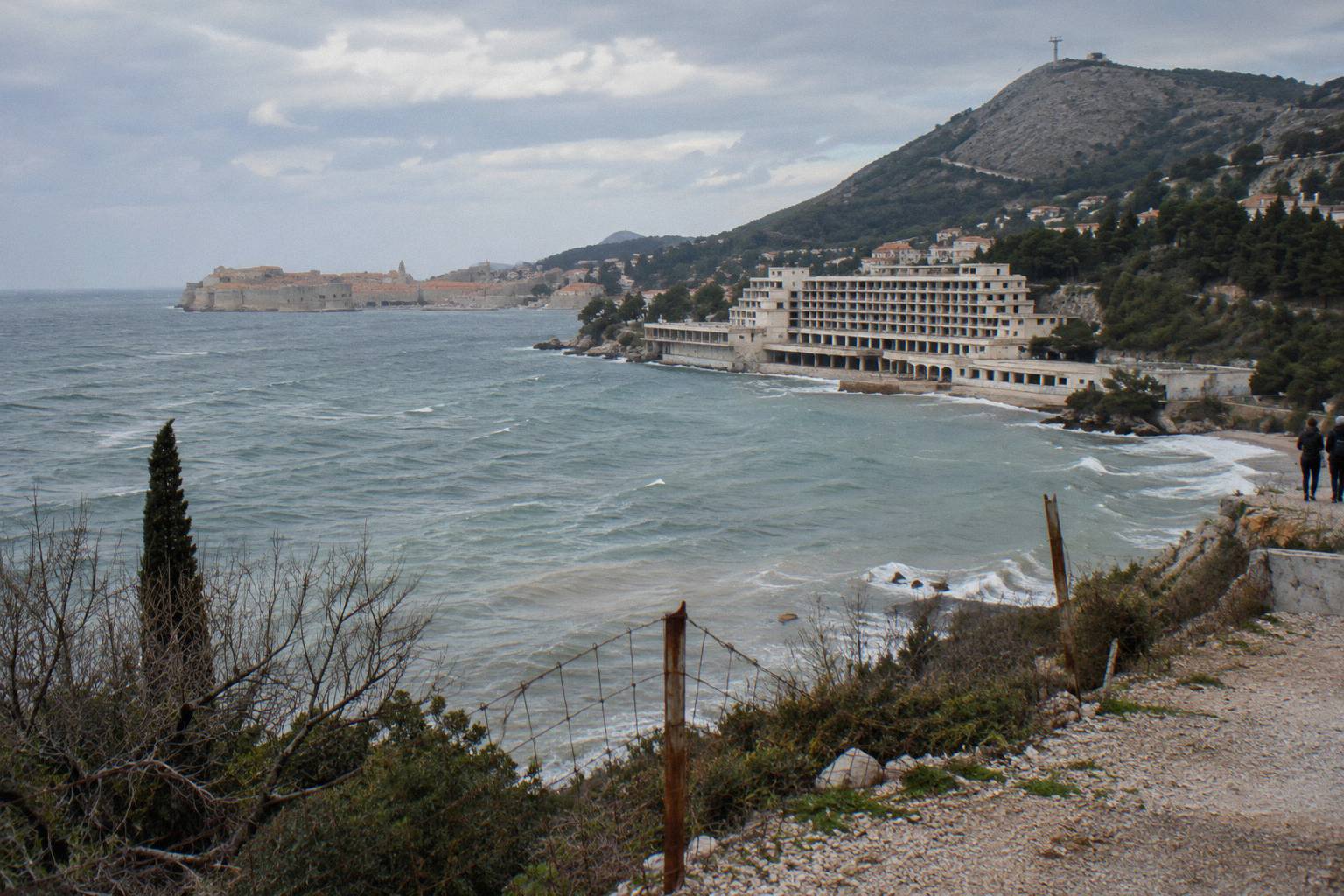
Kupari is still abandoned in the sense most visitors expect, because the empty, untouched parts of the site still dominate the view, yet it is no longer fully abandoned, which is the part most people have not heard. The abandonment is now only partial, so the idea of Kupari as a completely dead place is already out of date. The resort was left in ruins after being plundered and damaged in 1991, and it stayed that way for over three decades because the site sat unresolved while plans for its future came and went. In 2025 the ruins were largely demolished, with the protected Grand Hotel excepted, and construction of a luxury resort began. The honest answer today is: abandoned until recently, now a closed construction site that no visitor can enter.
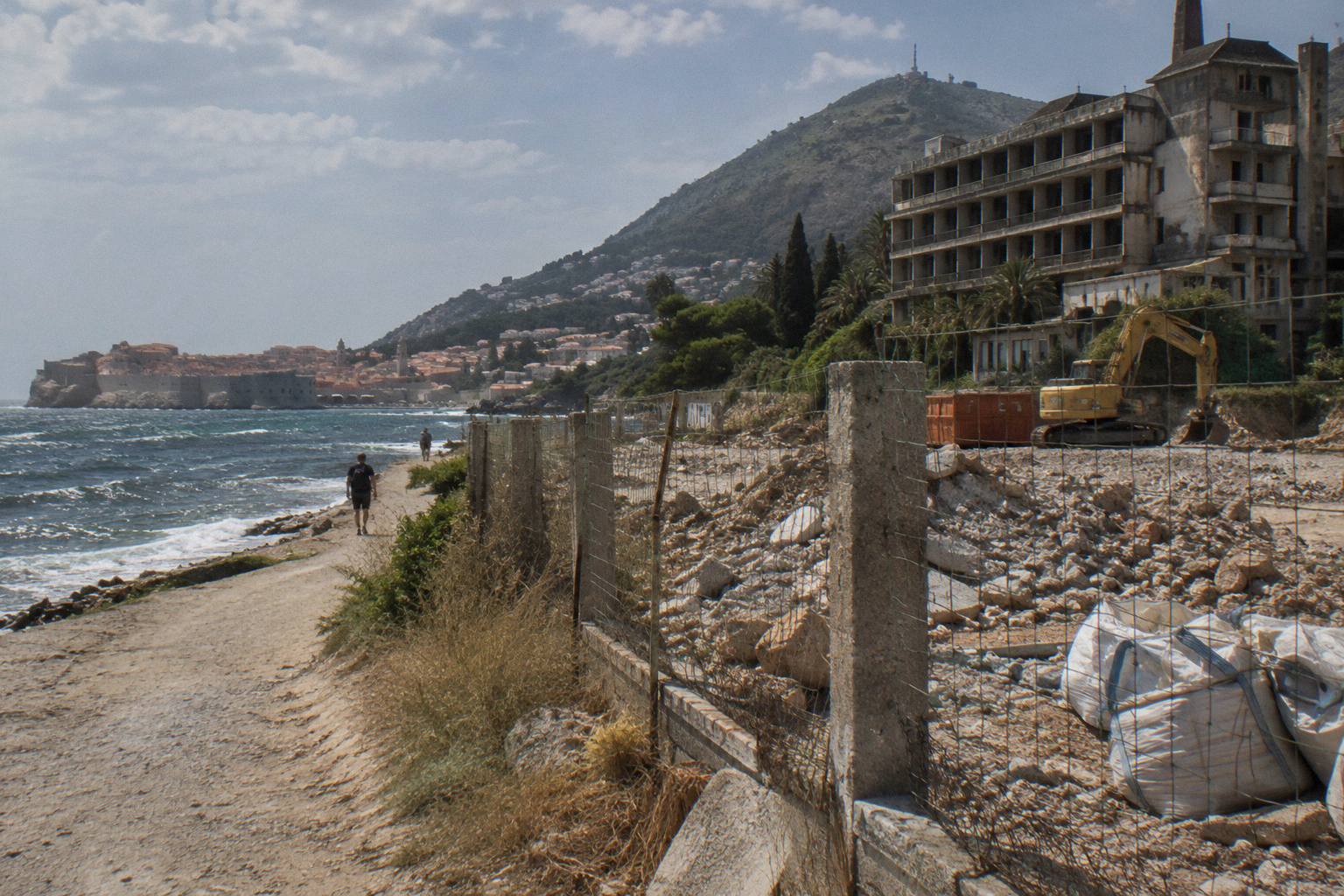
That sequence matters for anyone who read an older travel article or saw photos of crumbling hotels draped in pine trees. Those images are now historical. The Grand Hotel, the one building under heritage protection, survives, but the rest of the complex that urbex photographers documented for years has come down. The redevelopment is led by a major international hotel group, and the site is fenced and off limits, as The Dubrovnik Times reported when demolition began.
So if your question is really "can I still see the abandoned hotels at Kupari?", the answer is: only from outside the fence, from the road or the bay, and even then you will see a building site with one grand survivor rather than the ruin field that stood for thirty years. No tour enters the ruins, and none should be expected to.
If you want the Kupari story in context with Dubrovnik's wider war landscape, the two tours that cover it are private driving tours that describe the site from the road:
The first of those three, the Private War And Heritage Tour Of Mount Srđ by Adriatic Vision, is the one that actually names the Kupari area on its route, alongside Mount Srd and the Hotel Belvedere. The Half-Day Yugoslav War History by Amico Tours covers the Red History Museum and Fort Imperial, the Yugoslav and Homeland War context, and the third, the Driving Tour by INtours Dubrovnik, focuses on the front-line defence points of the siege.
What Was Kupari Before 1991?
Before 1991, Kupari was a holiday resort built and run by the Yugoslav People's Army, the military of socialist Yugoslavia, and it carried the nickname "Tito's Hawaii" for its crescent of hotels behind a pine-fringed bay east of Dubrovnik. Croatia was one of the republics of socialist Yugoslavia, which Josip Broz Tito led after the Second World War. The resort served as a vacation base for the army and its families, part of the wider network of state and military resorts along the Yugoslav Adriatic coast.
The nickname is worth pausing on. "Tito's Hawaii" tells you how the place was imagined at its height: a self-contained paradise of grand hotels, terraces and beaches a short drive from Dubrovnik, reserved for the military establishment. Background on the socialist state itself is covered in the Yugoslav era and communism tour guide, which explains how Dubrovnik's two history museums, the Red History Museum and the Homeland War Museum, split the story between the Yugoslav decades and the 1990s war.
For travellers interested in the Yugoslav side rather than the war side, the Red History Museum Visit by Red History Museum is the natural fit. It is a guided museum visit running 50 minutes to 1 hour 35 minutes, from €10 per person with admission included, rated 4.8 across 206 reviews, and it uses an interactive augmented reality app to walk you through everyday life in communist Yugoslavia. It is the cheapest per-person tour covered on this site and the most reviewed, with the widest review pool of any tour here.
What Happened To Kupari In 1991?
In 1991, when war reached the Dubrovnik area, the Kupari resort was plundered and damaged, and its time as a working resort came to a sudden end. The property was left broken by the conflict, and in every year since, it has never reopened. Croatia declared independence on 25 June 1991, and the siege of Dubrovnik followed, running from 1 October 1991 until it was lifted on 31 May 1992, with the heaviest shelling of the Old Town on 6 December 1991, as the city's own record of the destruction and restoration of Dubrovnik sets out. Kupari, as a military asset of the Yugoslav People's Army, did not escape the year.
What can be said plainly is limited to that: the resort was plundered and damaged in 1991 and never reopened. The wider war record, its causes, its casualties and its course are outside what this page can state, and the deep background belongs in the why was Dubrovnik bombed in 1991 post and the war history timeline 1991 to 1992.
The scale of what happened inside the Old Town gives the context: about two thirds of the Old Town's buildings were damaged in 1991 and 1992, and the walled city, inscribed by UNESCO in 1979, spent 1991 to 1998 on the World Heritage in Danger list. Kupari's destruction was of a different kind: not a medieval city shelled and rebuilt, but a modern resort stripped and abandoned, and then left for thirty years.
To stand in the places where that history is explained, three Old Town options work well. The Private Walk, 2h30 by My Dubrovnik Tours runs from €100 per person for 2 hours 30 minutes, covers war-damage sites from Ploce to Pile and includes entrance to the Memorial Room of Dubrovnik Defenders; it is led by a decorated war veteran, and its rating is 5 across 8 reviews, a small number of reviews. The Walk With Vesna, Group Rate by Walk with Vesna is a 2 hour private walk from €235 per group with a guide who was in the city during the siege, rated 5 across 5 reviews, again a small pool. The Controversial History Private Walk by ROSOTRAVEL Croatia, from €129 per person for 2 hours, traces the shell scars still visible on rooftiles and walls.
Why Did The Ruins Stay Empty For So Long?
Kupari stayed empty for more than thirty years because the site remained tied up in unresolved ownership disputes, unanswered heritage questions and development plans that failed, leaving the ruins in limbo. Nobody chose to preserve them; the abandonment was the accidental result of stalled decisions rather than any deliberate plan to keep the ruins as they were. The Grand Hotel's protected status complicated any redevelopment, and successive schemes for the bay stalled before a single project finally moved far enough to clear the site. Until that project arrived, there was neither the money nor the agreement to rebuild, and no reason to tear anything down.
The result was a long period in which Kupari became famous precisely for its emptiness: decaying hotels, shattered glass, pine trees growing through ballrooms. Photographers and urban explorers spread those images online, which is why so many people still arrive in Dubrovnik asking to see "the abandoned hotels". For a fuller account of that long empty stretch, see the why is Kupari still abandoned companion history and, for the neighbouring ruin that is still standing, the Hotel Belvedere guide.
That limbo also explains the confusion you will find online. Articles written before 2025 describe walking among the ruins, and some tour descriptions still advertise "abandoned hotel ruins" in a way that suggests entry. Read them carefully: the only access that exists today is from the road or a viewpoint, and any page that promises a walk inside the buildings is out of date or worse.
Can You Visit Kupari Today?
No, you cannot visit Kupari today. The site is a closed construction zone with no public access, and the ruins have largely been demolished, leaving nothing inside the fence for a visitor to see. Anyone hoping to explore the ruins up close will find the area off limits, so there is currently no way to enter or tour the Kupari site itself. What you can do is see the bay, the surviving Grand Hotel facade and the scale of the redevelopment from the road or the water, on a tour that stops at a viewpoint, or on your own by car along the coastal road east of Dubrovnik. Do not expect to walk inside any building, and no urbex visit should be attempted.
The tour that covers this honestly is the Private War And Heritage Tour Of Mount Srđ by Adriatic Vision, a private driving tour of 4 to 5 hours from €150 per person, with a minimum age of 10. Its route runs from Mount Srd and the Imperial Fortress war museum to the Hotel Belvedere and Kupari area, then back to Old Town memorials and War Photo Limited. Museum tickets are not included in its listed inclusions, which cover the tour guide. You can check availability alongside the in-depth Mount Srd war history and cable car guide.
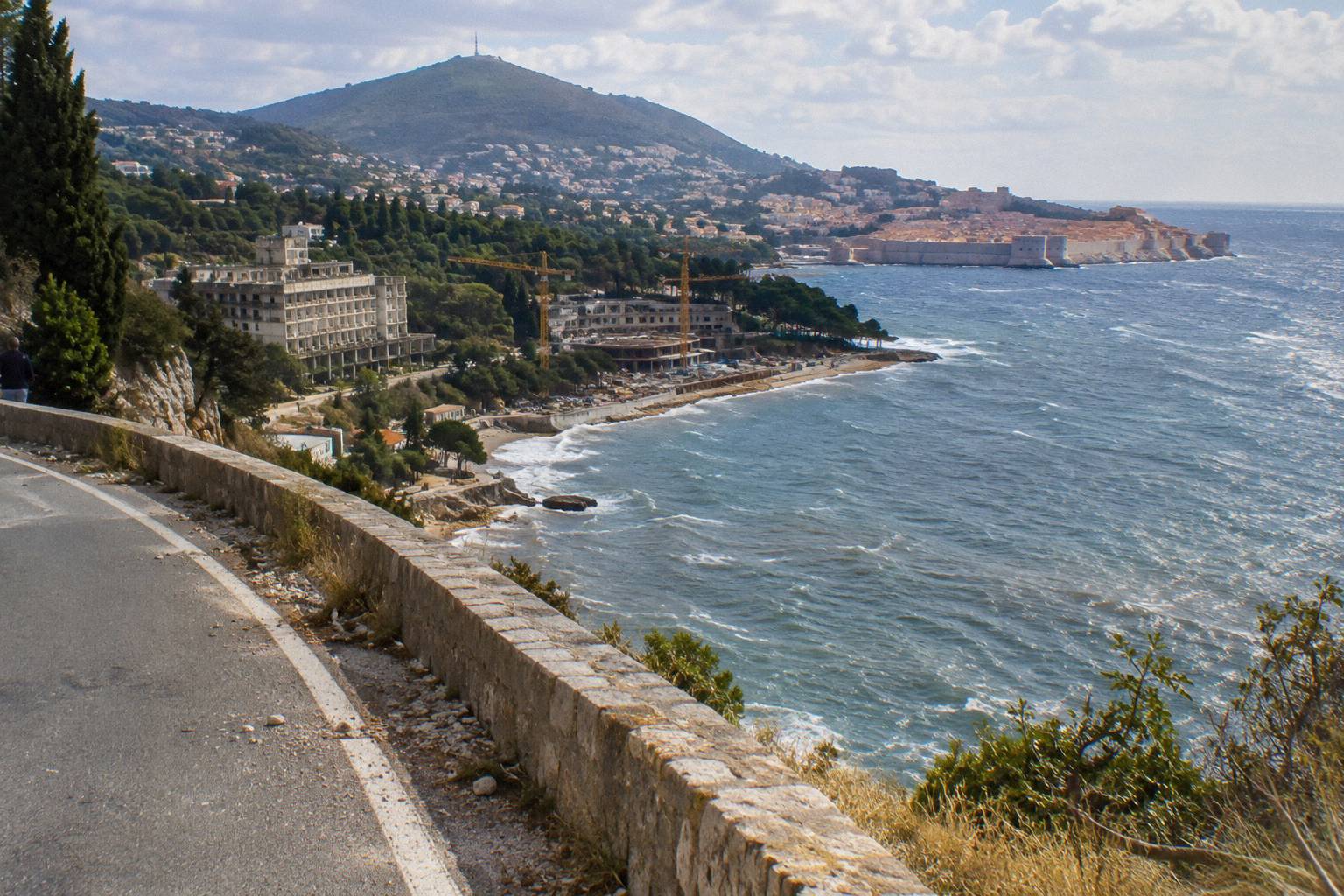
One seasonal caution belongs here. War Photo Limited, which the Adriatic Vision tour lists among its stops, keeps hours of 10:00 to 17:00 in April and October, 10:00 to 22:00 from May to September, and is closed November to March, with adult tickets at €10 and student tickets at €6, per its own visit page. Any tour that includes it is effectively a spring-to-autumn product; in winter that portion of the itinerary will differ. The War Photo Limited museum guide covers what the exhibition holds.
Which Tours Show You The Kupari Story?
One driving tour names Kupari, and two more cover the wider Yugoslav and Homeland War context: the Adriatic Vision private tour names Kupari and Belvedere directly, Amico Tours' half-day trip lists an optional Belvedere Hotel ruins stop with pickup included, and INtours' driving tour covers the siege's front-line defence points. All three are private except the Amico departure, which is a guided group drive. None of them enters the ruins, and each describes the site honestly from outside.
| Tour and operator | Format and length | Price | What it covers near Kupari |
|---|---|---|---|
| Private War And Heritage Tour Of Mount Srđ, Adriatic Vision | Private drive, 4 to 5 hours | From €150 per person | Kupari and Hotel Belvedere area, Mount Srd museum, Old Town memorials, War Photo Limited |
| Half-Day Yugoslav War History, Amico Tours | Guided drive, 4 hours | From €178 per person | Red History Museum, Fort Imperial, Ombla source; optional Belvedere Hotel ruins and War Photo Gallery |
| Driving Tour, INtours Dubrovnik | Private drive, 2 hours | From €180 per vehicle | Fort Imperial and front-line defence points of the siege |
The Half-Day Yugoslav War History by Amico Tours is the most expensive per-person tour with a clear basis on this site, from €178 per person, and it bundles the most: pickup and drop-off, an air-conditioned vehicle, an audio guide in six languages, and entrance to both the Red History Museum and the Homeland War Museum. The INtours Driving Tour, Per Vehicle, is led by a former Croatian soldier who defended Dubrovnik, and notes that Homeland War Museum entry is an extra at €5 per person, which matches the museum's own ticket price on its official site: €5 for adults, €3 for students, free under 7, with hours that shift by season, so check the day before you go.
If your interest is really the Yugoslav decades that built Kupari rather than the war that emptied it, the Red History Museum Visit by Red History Museum is the better spend: from €10 per person, admission included, rated 4.8 across 206 reviews, the most reviewed tour on this site. Free cancellation applies to every tour named on this page within a 24 hour window, so you can hold a place and decide closer to the day.
What Trips People Up When Planning A Kupari Visit
Three mistakes recur when people plan a Kupari visit: expecting to walk inside the ruins, trusting articles and photographs taken before the 2025 demolition, and planning a winter trip around War Photo Limited without realising it closes. All three are avoidable if you verify current access, source dates, and seasonal opening hours before you travel. Each one is avoidable with the information above. A fourth, smaller one is combining Kupari with a cable car plan without checking the winter timetable, since both the museum on Srd and the exhibitions in town keep seasonal hours.
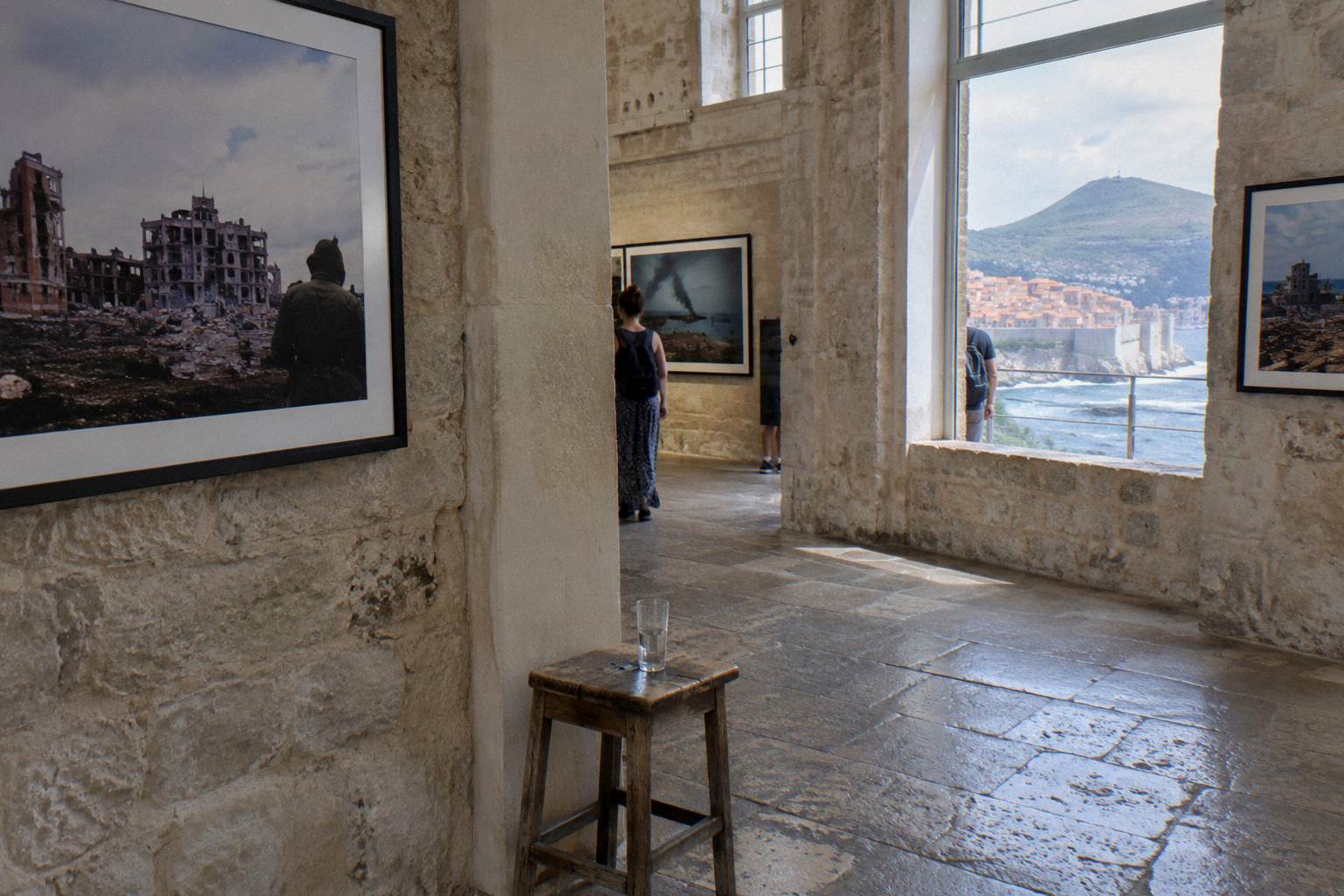
- Expecting entry: there is none, and no tour promises it. The closest you get is a road or viewpoint stop.
- Trusting old write-ups: the ruins were largely demolished in 2025; the Grand Hotel is the survivor, not the norm.
- Seasonal blind spots: War Photo Limited is closed November to March, so tours listing it change character in winter.
- Cable car assumptions: if you plan to ride up Mount Srd yourself, the cable car's own timetable shows seasonal hours with some winter closures; fares are €30 adult return, €17 one way, €8 for children 4 to 12, about a 4 minute ride. Fares change, so check the day before you go.
- Confusing Kupari with Belvedere: they are different sites a short distance apart, with different stories, covered separately in the Belvedere guide.
For help choosing between formats, the war walking tour versus jeep tour comparison and the private versus group war tour guide break down the trade-offs. The Kupari question is also covered from the safety angle in whether a Dubrovnik war tour suits kids, which matters because the Adriatic Vision tour sets a minimum age of 10.
The Walk With Vesna, Group Rate by Walk with Vesna, shown above, is the Old Town complement to any Kupari drive: a 2 hour private walk from €235 per group led by a guide who was in the city during the siege, rated 5 across 5 reviews, a small number of reviews, with an optional cable car and Fort Imperial extension on request (museum tickets not included). It is the most personal of the walking options for the restoration story, which pairs well with the war damage map of the Old Town.
How To Plan A Day Around Kupari And Mount Srd
Plan the day in two halves: a morning drive past Kupari and Hotel Belvedere, then an afternoon on Mount Srd at the Homeland War Museum. You can cover both either on a single private tour of 4 to 5 hours or independently with a car. The Adriatic Vision tour does the whole circuit in one booking. Independently, you drive the coastal road east for the viewpoint, then climb to Fort Imperial, where the museum charges €5 for adults and €3 for students. Add the Old Town museums according to season and you have the full story in one day.
Add the museums according to season. War Photo Limited sits in the Old Town and is an April to October visit; the Red History Museum, on Ulica Svetog Križa 3 in Nuncijata, covers the Yugoslav decades and is the natural bookend, either on its own ticket or through the museum's own guided walk. For length planning, the how long is a Dubrovnik war tour guide compares the 2 hour and half-day formats.
If a single booking appeals, the three tours below cover the Kupari area and its context from different angles:
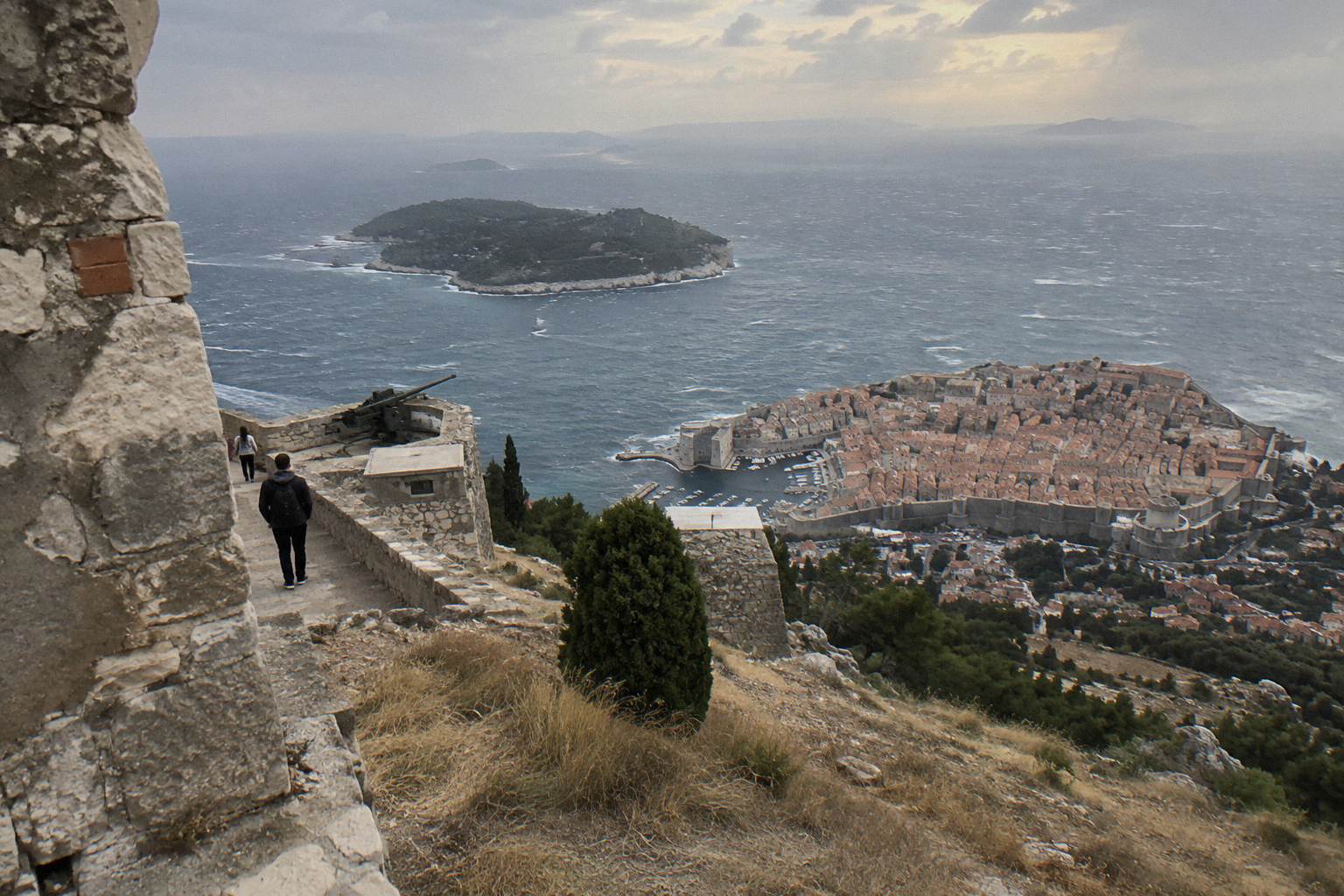
Whichever you pick, book with the 24 hour free cancellation in mind and confirm the day before, since winter hours shift at both the museum on Srd and the smaller Old Town exhibitions. Practical packing and clothing notes are in what to wear on a Dubrovnik war tour.
Common Questions About Kupari
Why Is Kupari Still Abandoned?
Kupari is only partly abandoned today. Plundered and damaged in 1991, the resort stood empty for over thirty years, but the ruins were largely demolished in 2025, the protected Grand Hotel excepted, and the site is now a closed construction zone for a luxury resort with no public access.
Can You Go Inside The Kupari Hotels?
No. There is no public access to the site and most of the ruins have been demolished. Tours that cover Kupari describe it from the road or a viewpoint, never from inside.
What Does Kupari Look Like Now?
A building site behind a fence, with the Grand Hotel facade preserved and heavy machinery where the other hotels stood. Older photographs of the ruin field no longer match reality.
Which Tours Include Kupari?
The Private War And Heritage Tour Of Mount Srđ by Adriatic Vision names the Kupari and Hotel Belvedere area on its route, and the Half-Day Yugoslav War History by Amico Tours lists optional Belvedere Hotel ruins. Both describe the sites from outside.
Is Kupari The Same As The Hotel Belvedere?
No. They are different sites a short distance apart with different histories. Belvedere is a single ruined hotel above Dubrovnik; Kupari was a multi-hotel military resort on its own bay, now under redevelopment.
Is It Worth Visiting Kupari In Winter?
The viewpoint itself can be visited year round, but be aware that War Photo Limited closes November to March and the Mount Srd museum keeps shorter hours in winter, so check the day before you go.