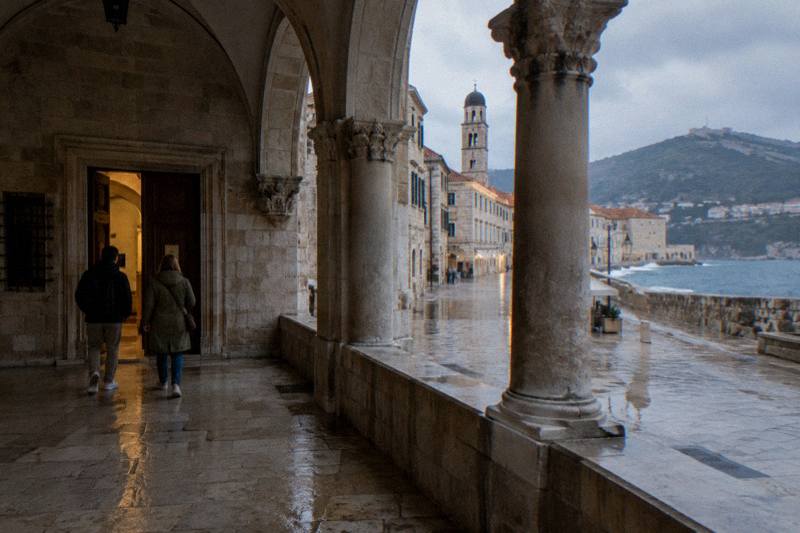
Dubrovnik War History: A 1991-1992 Timeline
The dates that matter, the places they touched, and the guided walks and driving tours that take you to each one.
Short answer
Croatia declared independence on 25 June 1991. The siege of Dubrovnik ran from 1 October 1991 to 31 May 1992, with the heaviest shelling of the Old Town on 6 December 1991. About two thirds of Old Town buildings were damaged, and the UNESCO site sat on the danger list from 1991 to 1998.
This timeline sits inside the site's history coverage. For the fuller picture of what the city endured, see the siege of Dubrovnik explained in plain terms, and for the wider frame, why Croatia split from Yugoslavia.
Quick Facts
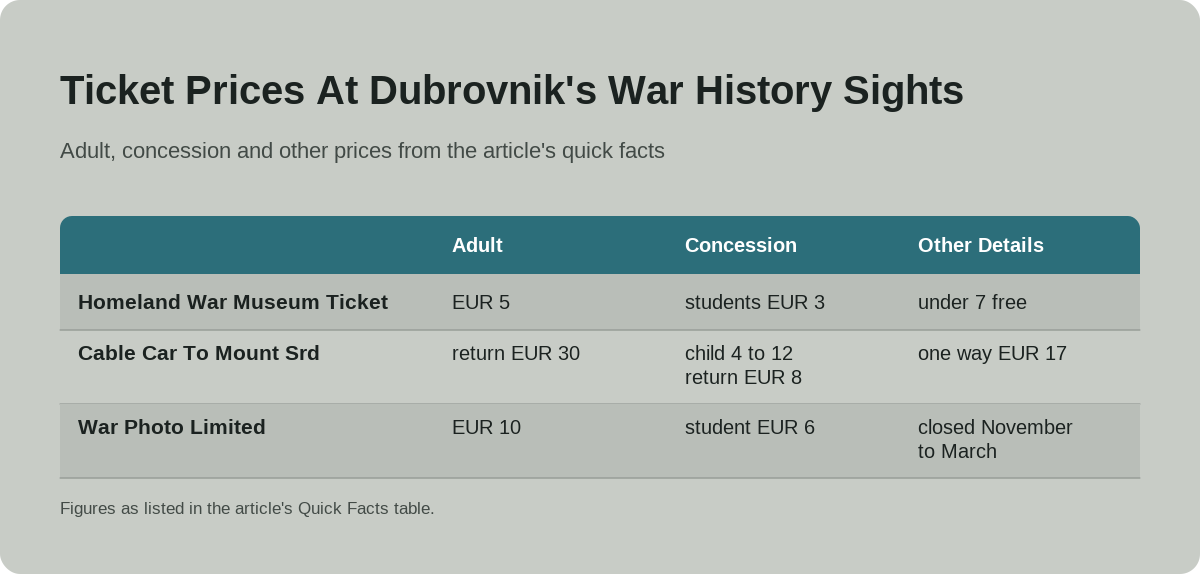
Five dates anchor this page: independence on 25 June 1991, the siege beginning 1 October 1991, the heaviest shelling of the Old Town on 6 December 1991, Kupari damaged in 1991, and the siege lifted on 31 May 1992. Around them sit the visitor numbers you actually need: the Homeland War Museum at EUR 5 for adults, the cable car at EUR 30 return, and War Photo Limited closed from November to March.
| Fact | Detail |
|---|---|
| Independence declared | 25 June 1991 |
| Siege of Dubrovnik | 1 October 1991 to 31 May 1992 (lifted) |
| Heaviest shelling of the Old Town | 6 December 1991 |
| Old Town buildings damaged in 1991-92 | About two thirds |
| UNESCO World Heritage inscription | 1979 |
| On the World Heritage in Danger list | 1991 to 1998 |
| Homeland War Museum ticket | Adult EUR 5, students EUR 3, under 7 free |
| Cable car to Mount Srd | Adult return EUR 30, one way EUR 17, child 4 to 12 return EUR 8 |
| War Photo Limited | Adult EUR 10, student EUR 6, closed November to March |
| Currency | Euro, since 1 January 2023 |
What Happened In Dubrovnik Between 1991 And 1992?
Croatia declared independence on 25 June 1991. The siege of Dubrovnik began on 1 October 1991 and was lifted on 31 May 1992. The heaviest shelling of the Old Town came on 6 December 1991, and about two thirds of its buildings were damaged across 1991 and 1992. The Old Town, a UNESCO World Heritage site since 1979, was placed on the danger list from 1991 to 1998.
Croatia was one of the republics of socialist Yugoslavia, which Josip Broz Tito led after the Second World War. That context is the frame for everything on this page, but the timeline itself is deliberately narrow: only the dates that are documented belong here. Anything about causes, casualties, commanders or ceasefire details is outside what this page can verify, so you will not find it below. What you will find is a sequence of dated events, each tied to a place in and around Dubrovnik that you can visit today, often with a guide who knows the ground.
The independence declaration of 25 June 1991 is the first marker. The second is the start of the siege on 1 October 1991. Between those two dates the situation escalated, and the city found itself encircled with its medieval core inside the perimeter. That detail matters for visitors: Dubrovnik's Old Town is not a monument standing apart from modern history. It was inside the events, and its walls and rooftops carry the record.
| Date | Event | Where it shows today |
|---|---|---|
| 1979 | Old Town inscribed as a UNESCO World Heritage site | The walled city itself |
| 25 June 1991 | Croatia declared independence | Republic-wide; marked nationally |
| 1 October 1991 | Siege of Dubrovnik begins | The city and its surroundings |
| 1991 | Kupari military resort plundered and damaged | Kupari bay (no public access today) |
| 6 December 1991 | Heaviest shelling of the Old Town | Rooftop and wall scars still visible |
| 1991 to 1998 | Old Town on the World Heritage in Danger list | UNESCO record; restoration visible |
| 31 May 1992 | Siege lifted | City-wide; commemorated locally |
| 2025 | Kupari ruins largely demolished, Grand Hotel excepted | Site under redevelopment |
Read down that table and the shape of the year becomes clear: a summer declaration, an autumn encirclement, a single devastating day in December, and a spring lifting. The gap between 6 December 1991 and 31 May 1992 is deliberately left without intermediate entries, because this page prints only verified dates. The fuller siege guide covers what those months meant for the city.
One practical note on the last row. Kupari appears in the timeline because it was damaged in 1991, but its 2025 demolition means the ruined resort that many older articles describe no longer exists in that form. The protected Grand Hotel shell remains; the rest of the site is a construction project. Any visit is from the road or a viewpoint, never inside.
A second note concerns the UNESCO row. The 1979 inscription predates the war by twelve years and is what made the 1991 damage an international heritage story as well as a local one. The danger-listing that ran from 1991 to 1998 tracked the restoration, and its end in 1998 marks the point at which the rebuilt city was judged out of danger. When you look at the repaired rooftiles today, you are looking at the outcome of that decade of work.
Where Did The War Touch The Old Town?
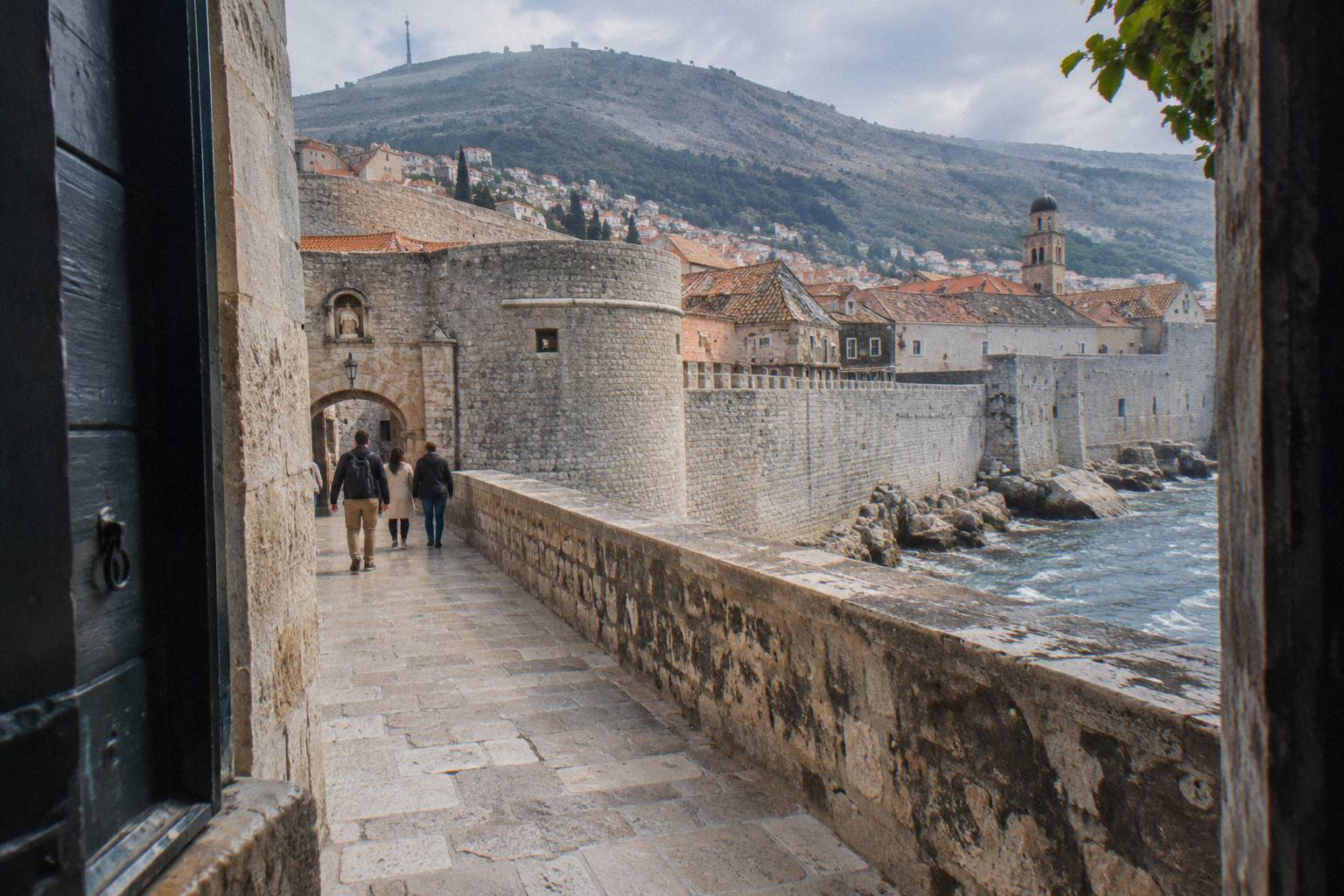
About two thirds of the Old Town's buildings were damaged in 1991 and 1992, with the worst of it on 6 December 1991. The restoration that followed was extensive enough that the city came off UNESCO's danger list in 1998. Today the evidence is subtle: repaired rooftiles, patched walls and memorial plaques rather than open ruins, which is exactly why a guided walk adds so much here.
The Old Town looks intact, and that is the point. The restoration programme after the siege rebuilt what was broken, so a visitor walking down the Stradun sees a finished city, not a damaged one. The traces are there for someone who knows where to look: replaced sections of rooftile in slightly different tones, shell scars on stone, and the memorial spaces that record the defenders. The city's own record of the destruction and restoration is kept by Dubrovnik on its official page on the destruction and restoration of the Old City, and UNESCO's listing documents the danger-list period from 1991 to 1998.
This is where the walking tours earn their price. The Controversial History Private Walk by ROSOTRAVEL Croatia, from €129 per person, is a two-hour private walk built around the Old Town's rooftiles and walls where 1991 shell scars remain, led by a licensed private guide. The War Photo Limited, Lovrjenac tour from the same operator, from €140 per person, adds War Photo Limited tickets and a route through Pile Gate, Buza Gate, Minceta Tower and the West Harbour, with Lovrjenac Fortress skip-the-line in the three-hour option.
The Walk With Vesna, Group Rate walk takes a different angle on the same ground. It is a two-hour private tour from €235 per group, led by a guide who was in the city during the siege, focused on the Old Town's restoration traces, with an optional cable car trip to Srd and the Homeland War Museum on request (museum tickets not included). It is rated 5 across 5 reviews, a small number of reviews. You can check availability for it directly, or compare it first with whether a walking or driving tour suits you.
A third walking option belongs here too. The Private Walk, 2h30 by My Dubrovnik Tours crosses the Old Town from the Ploce to Pile gates, stopping at the Memorial Room of Dubrovnik Defenders with entrance included. Between the three walks, the Old Town chapter of the timeline is fully covered on foot: the shell scars, the restoration, and the memorial that records the cost. The walk you choose depends on how long you want to be on your feet and whether you want the museum ending.
Which Tours Visit The Places In This Timeline?
Three formats cover the timeline's locations: private Old Town walks that read the shell scars and memorials on foot, driving tours up to the Homeland War Museum in Fort Imperial on Mount Srd, and museum visits at the Red History Museum for the Yugoslav background. Prices run from €10 per person for the Red History Museum Visit to from €178 per person for the Half-Day Yugoslav War History tour.
Start with the walking option most tied to this page. The Private Walk, 2h30 by My Dubrovnik Tours runs from €100 per person for two hours thirty minutes, crossing the Old Town from the Ploce to Pile gates to the war-damage sites and the Memorial Room of Dubrovnik Defenders, with Memorial Room entrance included. It is led by a decorated war veteran, and it is rated 5 across 8 reviews, again a small number of reviews. Free cancellation applies up to 24 hours ahead.
For the Mount Srd chapters, the Driving Tour, Per Vehicle by INtours Dubrovnik costs from €180 per vehicle for two hours, visiting the Homeland War Museum in Fort Imperial and the front-line defence points of the siege, with a former Croatian soldier as driver-guide. Museum entry is not included and costs EUR 5 per person at the museum. The Homeland War Museum, Transport tour by ROSOTRAVEL Croatia, from €268, includes skip-the-line museum tickets and, in its three-hour option, private transport to and from Mount Srd.
There is also a panorama option worth naming. The Dubrovnik Panorama And War Bunkers Tour by Dubrovnik Tours & Transfers is a two-and-a-half-hour private drive from €200 per group with pickup included, taking in Mount Srd, the Franjo Tudjman Bridge, the Ombla River and historic war bunkers, with a professional driver-guide. It includes no museum tickets, so it suits travellers who want the geography of the siege from above more than the exhibition inside Fort Imperial.
On the Yugoslav side of the story, the Half-Day Yugoslav War History tour by Amico Tours is a four-hour guided drive from €178 per person with pickup included, visiting the Red History Museum, the Homeland War Museum at Fort Imperial, the Ombla River source, and optional stops at the Belvedere Hotel ruins and the War Photo Gallery, with both museum entrances included. It carries an audio guide in English, Spanish, French, Italian, Portuguese and German, runs in air-conditioned Mercedes vehicles, and includes pickup and drop-off. The Red History Museum Visit, from €10 per person, is the shortest and cheapest way to add that context: a 50 minute to 1 hour 35 minute museum visit with admission included, rated 4.8 across 206 reviews, the most reviewed tour covered on this site.
A word on how these combine. Many visitors pair a short Old Town walk in the morning with the cable car or a driving tour to Fort Imperial in the afternoon, since the museum sits several hundred metres above the city and the two experiences answer different questions: the walk shows damage and restoration at street level, the museum explains the defence of the height itself. If you only have time for one, the guide to the Homeland War walking tours breaks down the trade-offs.
Cancellation terms are consistent across every tour named on this page: all of them carry free cancellation up to 24 hours ahead. That matters in a city where the bora wind can close the cable car and rough weather can spoil a mountain viewpoint, so a late change of plan costs nothing if you act a day ahead.
What Is The Homeland War Museum On Mount Srd?
The Homeland War Museum sits inside Fort Imperial on Mount Srd, the Napoleonic fortress above Dubrovnik. Entry costs EUR 5 for adults, EUR 3 for students, and is free for children under 7. Hours change by season: 08:30 to 22:00 from April to September, 09:00 to 20:00 in October, 09:00 to 17:00 from November to March. Check the day before you go.
The museum is the anchor of the Mount Srd chapter of the timeline. Its exhibits cover the defence of Dubrovnik from the fortress during the siege, and the building itself is part of the story. The official site at mdrd.hr carries current opening information, which is worth a look the day before any visit, since winter hours are short and weather on the mountain can affect plans.
Getting there is its own decision. The Dubrovnik Cable Car runs to the top of Srd in about 4 minutes, with an adult return at EUR 30, one way at EUR 17, and a child return (ages 4 to 12) at EUR 8. It runs seasonal hours with some winter closures, and fares change, so check the timetable and prices before you go. The driving tours above skip the cable car question entirely by taking you up by road. There is a fuller comparison in whether Mount Srd is worth it.
| Way up Mount Srd | Cost | Notes |
|---|---|---|
| Cable car, adult return | EUR 30 | About 4 minutes each way, seasonal hours |
| Cable car, adult one way | EUR 17 | Some visitors walk down |
| Cable car, child 4 to 12 return | EUR 8 | |
| Driving Tour, Per Vehicle | From €180 per vehicle | Museum entry EUR 5 per person extra |
| Homeland War Museum, Transport | From €268 | Skip-the-line museum tickets included |
| Private War And Heritage Tour Of Mount Srđ | From €150 per person | 4 to 5 hours, minimum age 10 |
Note what each row includes. The INtours Dubrovnik driving tour keeps its price low by leaving museum tickets out, so budget the EUR 5 per person on top. The ROSOTRAVEL Croatia museum tour bundles skip-the-line entry. The Private War And Heritage Tour Of Mount Srđ by Adriatic Vision is the longest option at 4 to 5 hours, combining the fortress and war museum with Old Town memorials and War Photo Limited, and its route passes the Hotel Belvedere and Kupari Resort sites from the road only. War Photo Limited's November to March closure makes that itinerary seasonal.
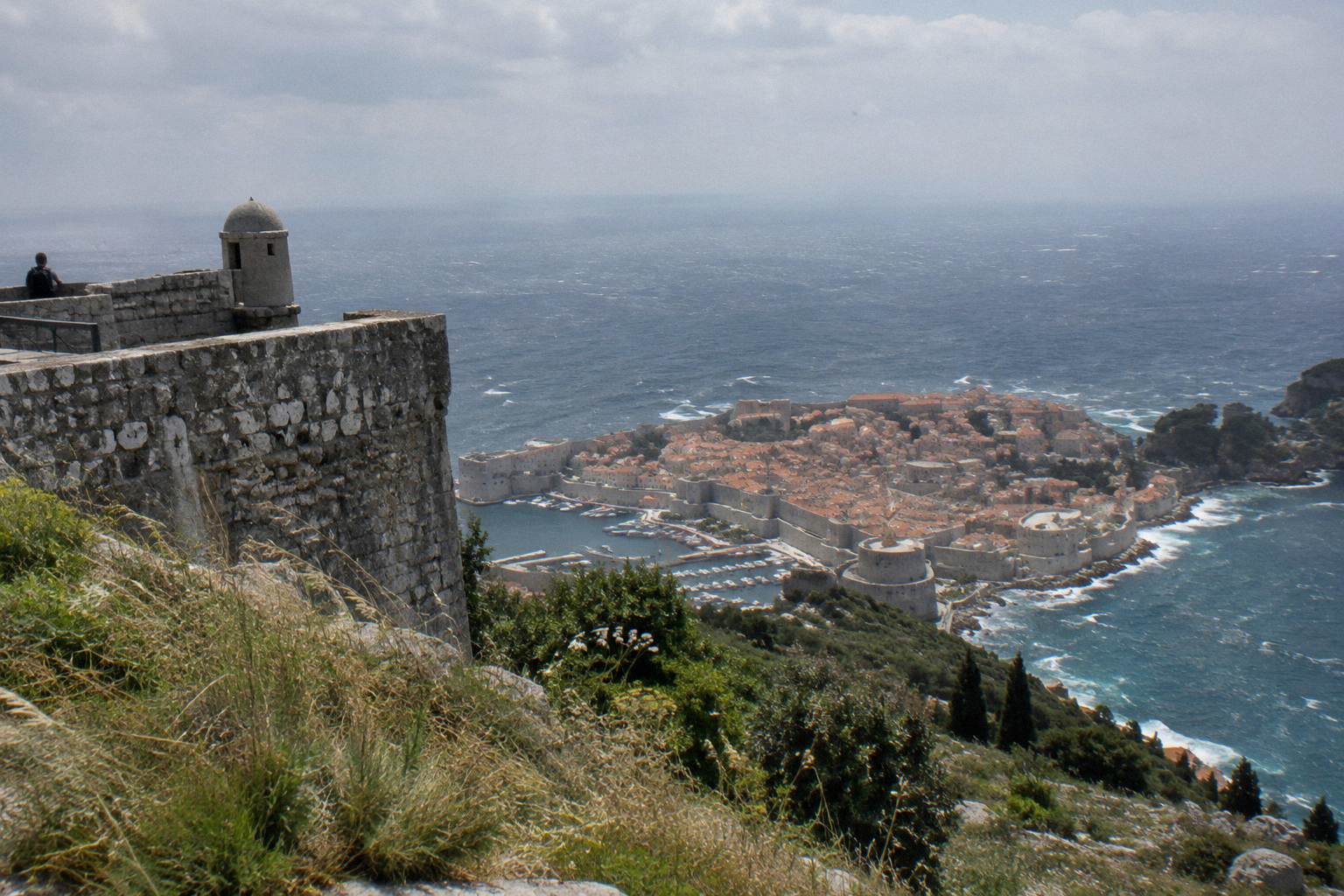
One more thing belongs in the planning: the view. Fort Imperial stands several hundred metres above the city, and the panorama from the terrace in front of the museum is the single best vantage point for understanding the geography of this timeline, with the Old Town walls below, Lokrum island offshore, and the hills behind where the front lines ran. Most visitors spend longer looking at the view than in the exhibition, so leave more time than the museum's modest size suggests.
What Happened At Kupari And Hotel Belvedere?
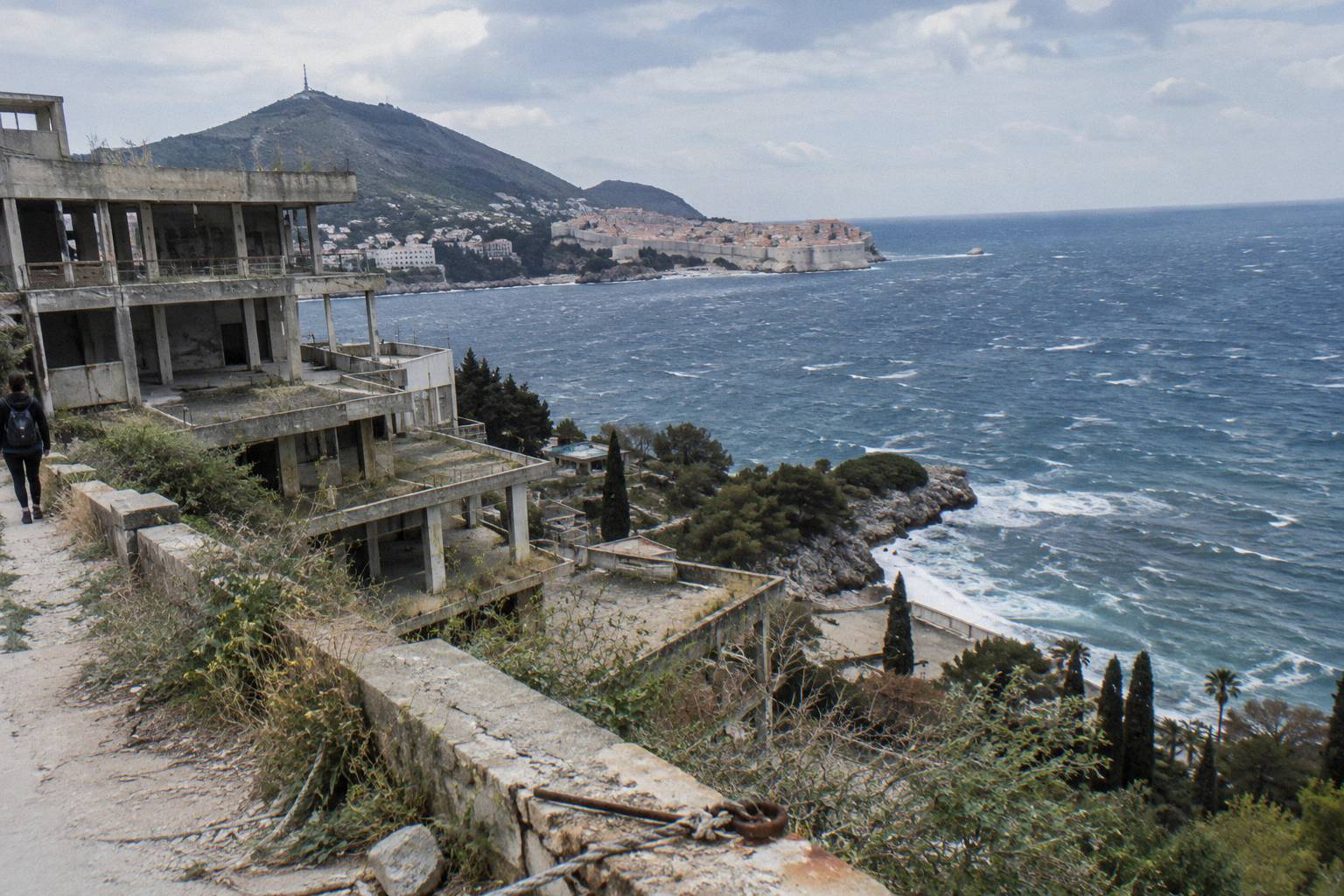
Kupari was a Yugoslav People's Army military resort, nicknamed Tito's Hawaii, that was plundered and damaged in 1991. Its ruins were largely demolished in 2025, with the protected Grand Hotel excepted, and the site is now under redevelopment with no public access. The Hotel Belvedere, damaged in the same period, is likewise closed, so tours mention both from the road or a viewpoint rather than entering.
This is the part of the timeline where older guidebooks mislead readers. For years, Kupari's wrecked hotels were a well-known stop for travellers interested in abandoned places. That era ended in 2025, when most of the ruins were demolished ahead of redevelopment into a luxury resort. The transformation is documented by The Dubrovnik Times' report on the Kupari redevelopment. The Grand Hotel, a protected structure, still stands, but behind a construction boundary.
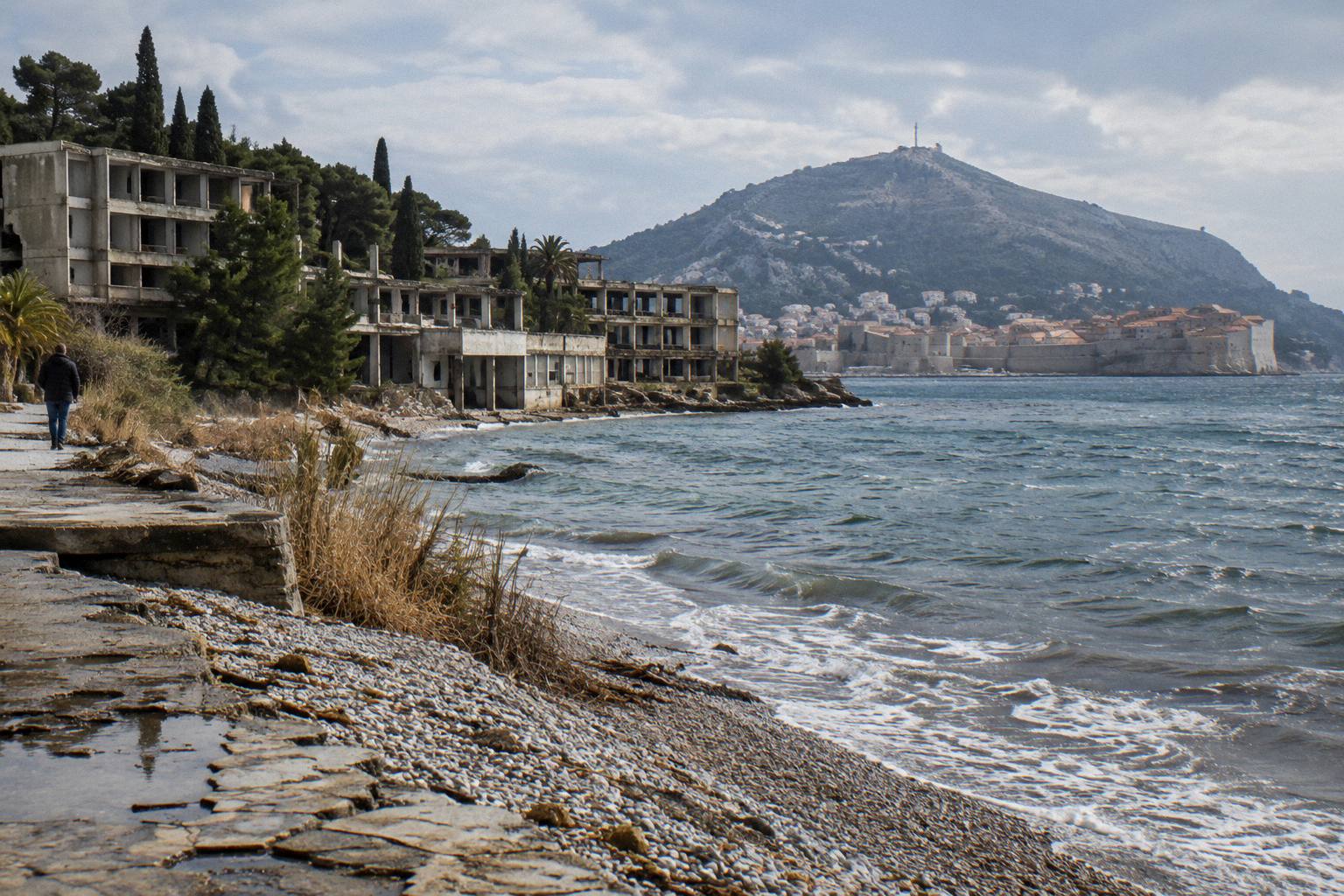
What does that mean for a visitor following this timeline? Realistic expectations. The Half-Day Yugoslav War History tour by Amico Tours lists optional Belvedere Hotel ruins and War Photo Gallery stops, and the Private War And Heritage Tour Of Mount Srđ lists the Hotel Belvedere and Kupari Resort. Both should be read as sightseeing from outside: you see the bay, the protected hotel shell and the construction site, not the interiors that photographers once documented. Do not expect entry, and do not attempt it; there is no public access. The detailed background, including what remains today, is in the guide to Kupari's abandoned hotels and the history of Hotel Belvedere.
The background worth carrying with you is short. Kupari was a resort run for the Yugoslav People's Army, the state's military, and its nickname, Tito's Hawaii, points to the era when officers holidayed on that pebble beach. It was plundered and damaged in 1991, during the same period as the siege. The Hotel Belvedere, on the cliffs above Dubrovnik's eastern approaches, was damaged in the same period. Two sites, one date, and both now readable only from a distance, which is precisely how the tours that include them present them.
Is War Photo Limited Open Year-Round?
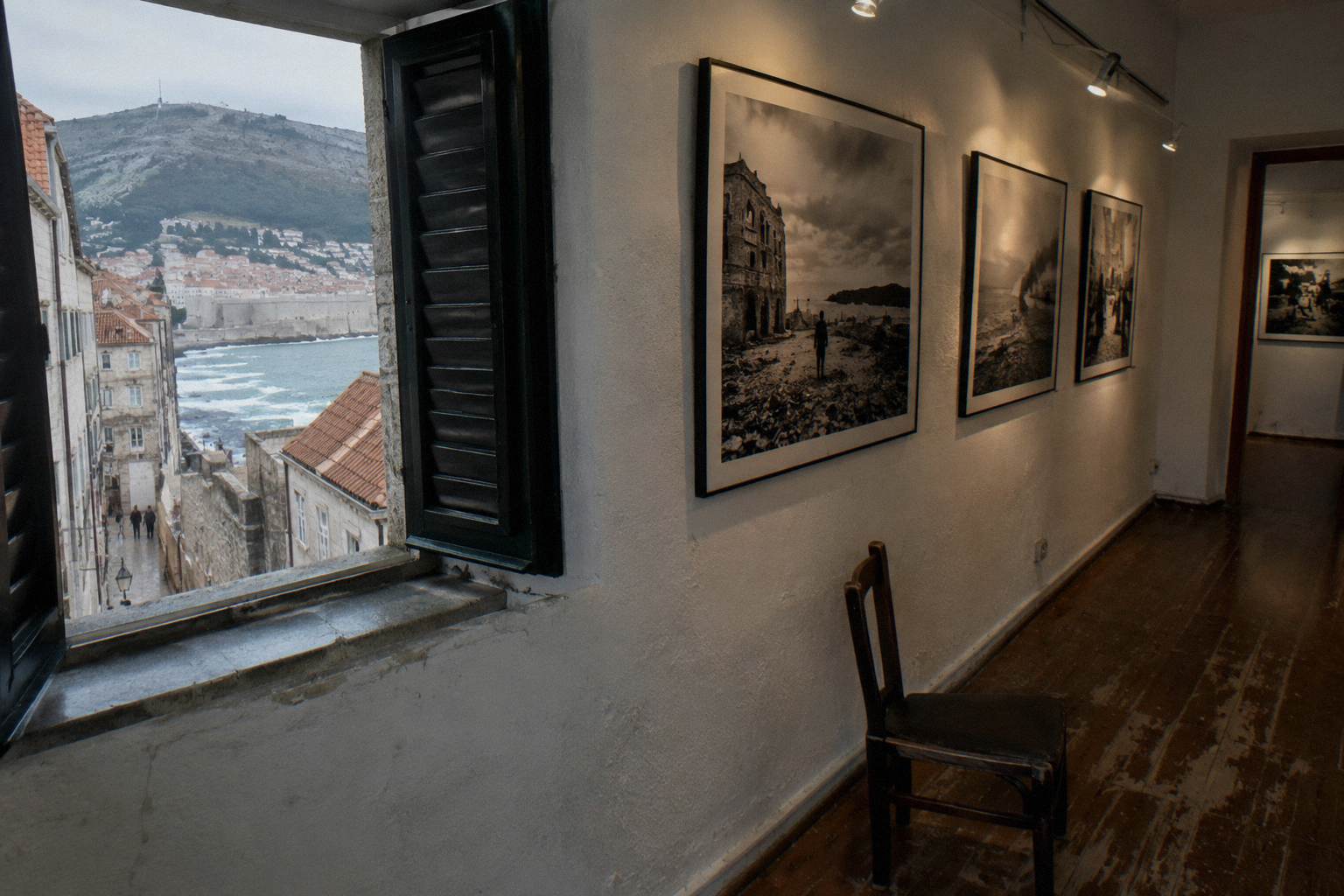
No. War Photo Limited, the war photography gallery in the Old Town, is open 10:00 to 17:00 in April and October and 10:00 to 22:00 from May to September, and it closes completely from November to March. Tickets are EUR 10 for adults and EUR 6 for students. Any tour that includes the gallery is therefore a seasonal product.
The gallery holds rotating exhibitions of conflict photojournalism, and its inclusion in two tours on this site, the War Photo Limited, Lovrjenac walk and the heritage drive up Srd, makes those itineraries weather- and calendar-dependent. If you are travelling between April and October, the ROSOTRAVEL Croatia walk from €140 per person includes gallery tickets plus the Old Town gates route; check its own visiting page for exhibition details. In winter, choose an itinerary built around the Old Town and Fort Imperial instead, both of which stay open.
The seasonal pattern is worth planning around rather than against. May to September gives you the longest gallery hours, until 22:00, which pairs neatly with an evening in the Old Town after a morning walk. April and October shorten to 17:00, so the gallery belongs earlier in the day. From November to March, swap it for the Red History Museum or the Homeland War Museum, and save War Photo Limited for a spring or autumn return trip.
How Do You Turn This Timeline Into A Day Of Visiting?
Pair one walking tour with one Mount Srd visit. Morning works for the Old Town on foot, afternoon for Fort Imperial by cable car or driving tour, and the Red History Museum slots in on a second day or a quiet afternoon for the Yugoslav background. Check museum hours the day before, and treat any itinerary including War Photo Limited as April to October only.
The mistakes that trip people up are consistent. The first is assuming the Old Town shows its history openly; without a guide, most visitors walk past every scar. The second is going up Srd in winter without checking the cable car timetable, since closures happen. The third is expecting Kupari or Belvedere to be enterable. The fourth is booking a gallery-inclusive tour for a December trip. Each of those is avoidable with a day's planning, and the what you actually see on a Dubrovnik war tour guide covers the practicalities in more depth.
For the Yugoslav context that precedes the timeline, the Red History Museum is the single best stop, and its guided walk is the cheapest tour on this site. The communism and Yugoslav-era tour guide explains what the museum covers and how it fits with the war-focused itineraries. Everything bookable through Dubrovnik Communism Tours carries free cancellation up to 24 hours ahead, which helps when weather on the mountain turns.
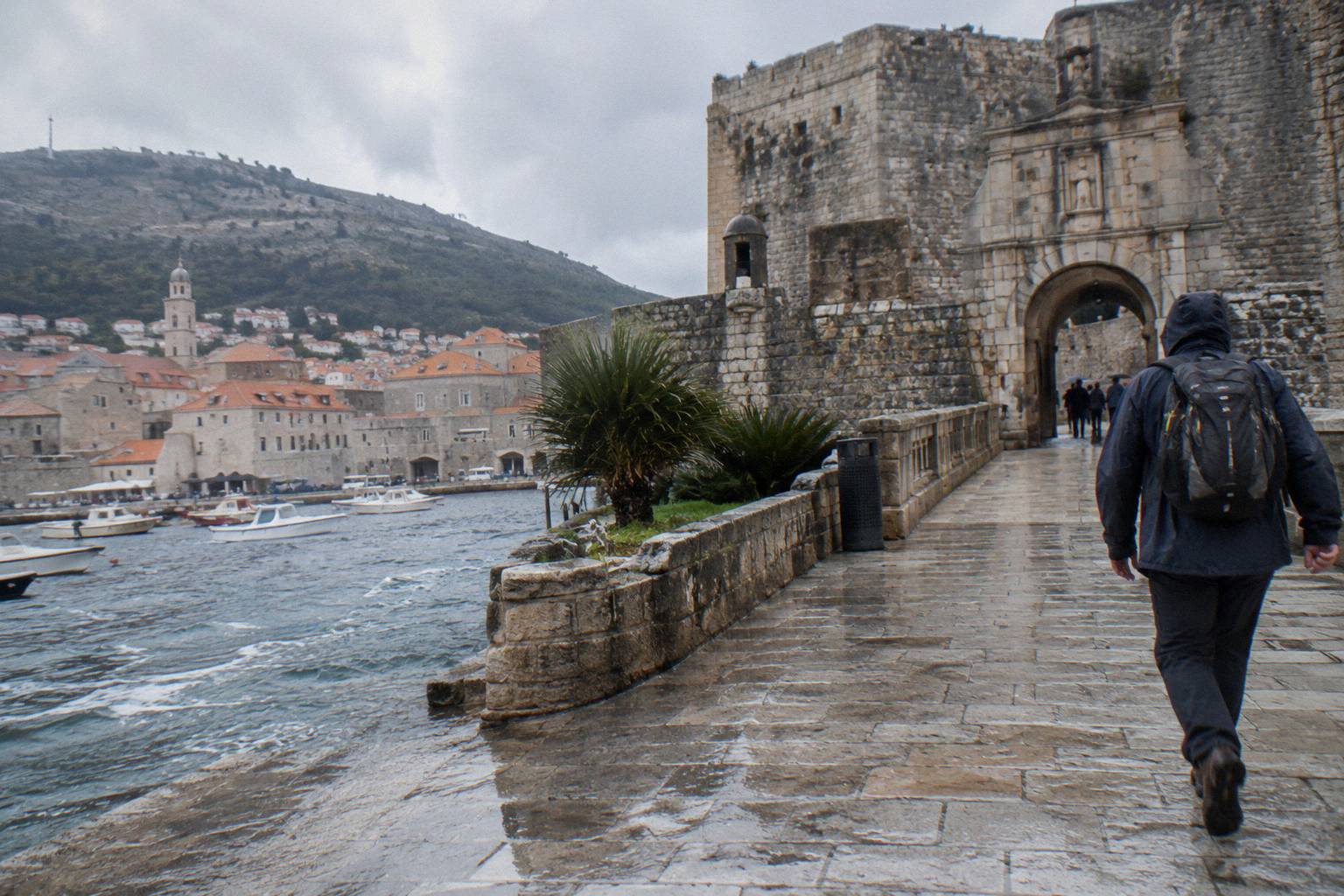
A sample day built strictly from the verified dates looks like this. Start at the Pile Gate, the western entrance to the Old Town. After lunch, take the cable car or a driving tour up to Fort Imperial and read the defence of the mountain against the panorama below. That single day touches the December 1991 shelling, the restoration years and the siege itself, in that order.
A second common slip is price comparison across formats. A per-group walk from €235, a per-person walk from €100 and a per-vehicle drive from €180 are not directly comparable; the honest comparison depends on how many people are travelling. The private versus group war tour guide works through the arithmetic.
Common Questions About Dubrovnik's 1991-1992 War History
When Was Dubrovnik Under Siege?
From 1 October 1991 until the siege was lifted on 31 May 1992. The heaviest shelling of the Old Town came on 6 December 1991.
How Much Of The Old Town Was Damaged?
About two thirds of the Old Town's buildings were damaged in 1991 and 1992. The restoration that followed ran through the 1990s, and the site left the UNESCO danger list in 1998.
When Did Croatia Declare Independence?
On 25 June 1991, while Croatia was still one of the republics of socialist Yugoslavia. The siege of Dubrovnik followed that autumn.
Can You Visit The Homeland War Museum?
Yes. It sits in Fort Imperial on Mount Srd, with adult tickets at EUR 5 and students at EUR 3. Hours change by season, so check the day before you go.
Can You Go Inside The Kupari Ruins?
No. The ruins were largely demolished in 2025 and the site is under redevelopment with no public access. Tours that mention Kupari describe it from the road or a viewpoint.
Is War Photo Limited Open In Winter?
No. The gallery closes from November to March. Between April and October it opens daily, and the tours that include it run in that window.
Keep Reading
The pages below go deeper on each chapter of this timeline: the siege itself, the map of where the shells landed in the Old Town, the fortress museum on Mount Srd, and the practical question of how long a war tour takes. Read the ones that match the days you have, then come back to the tour options above when you are ready to book a date.